
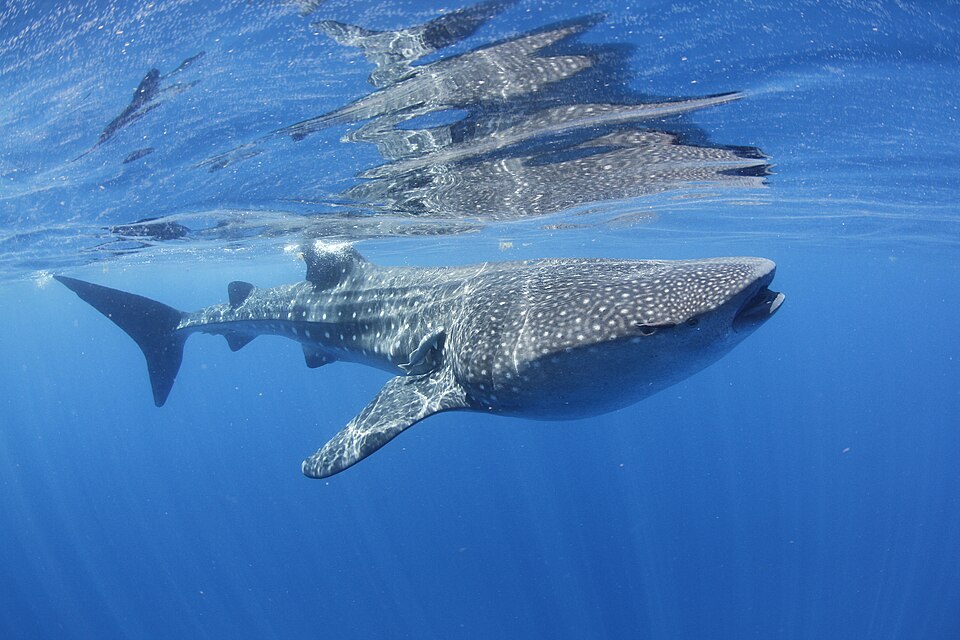
Despite being the largest fish in the ocean, whale sharks have become increasingly threatened by human activity. Over the past several decades, populations have declined by more than 50%, leading to their classification as Endangered by the International Union for Conservation of Nature (IUCN). Threats such as overfishing, accidental capture, and collisions with ships have placed enormous pressure on the species. However, recent conservation efforts and stronger international protections have created hope for their survival. As scientists continue to uncover the mysterious behaviors and migration patterns of whale sharks, understanding their unique adaptations and ecological importance may be the key to protecting these gentle giants.
| Common Name | Whale Shark |
| Binomial | Rhincodon typus |
| Class | Chondrichthyes |
| Order | Orectolobiformes |
| Family | Rhincodontidae |
| Distribution | Tropical and warm-temperates worldwide |
| IUCN Status | Endangered |
Adaptations and Behavior

Whale sharks have evolved to have incredible adaptations that allow them to survive in the open ocean. As the largest living fish, whale sharks commonly reach lengths of 5.5 to 10 meters, although some individuals can grow to over 18 meters. Despite their intimidating size, these massive sharks are generally slow-moving and harmless to humans. Their bodies are characterized by broad, flattened heads, large mouths, powerful tails, and distinctive patterns of white spots and stripes across their dark gray skin. These patterns are unique to each individual, similar to human fingerprints, allowing scientists to identify and monitor whale sharks through photographs. Although their exact purpose remains uncertain, the markings may also provide some camouflage in their natural environment. Unlike bony fish, whale sharks possess skeletons made of cartilage, which is lighter and more flexible than bone.
Whale sharks tend to be solitary animals, although large groups can occasionally gather in areas with abundant food. They inhabit tropical and warm-temperate oceans around the world, frequently traveling between coastal waters and the open ocean in search of suitable feeding grounds. These migrations can cover thousands of kilometers, making whale sharks one of the ocean’s most wide-ranging animals. Their behavior is often influenced by seasonal changes in water temperature and food availability, particularly plankton blooms and fish spawning events. Although whale sharks are commonly observed swimming near the ocean’s surface, they are also capable of diving to depths exceeding 1,000 meters. These long-distance movements make studying and protecting the species particularly challenging, as individuals frequently travel across international borders.
Another important trait of whale sharks is their extremely slow reproductive cycle. Scientists estimate that females may not reach sexual maturity until approximately 30 to 40 years of age, making them particularly vulnerable to population declines. Unlike many fish that lay eggs externally, whale sharks are ovoviviparous, meaning their eggs develop and hatch inside the mother’s body before the young are born alive. In one remarkable discovery, a pregnant female was found carrying more than 300 embryos at different stages of development. However, much of their reproductive behavior remains a mystery, including where females give birth and how frequently they reproduce. Their slow development, combined with an estimated lifespan of 70 to 100 years, means that populations can take decades to recover from significant losses.
Diet and Feeding

Despite their enormous size, whale sharks feed primarily on some of the smallest organisms in the ocean. They are filter feeders, consuming plankton, krill, small fish, fish eggs, and other tiny marine organisms. Unlike most sharks, which hunt larger prey using sharp teeth, whale sharks rely on their enormous mouths and specialized filtering structures to capture food. When feeding, they swim slowly through areas with high amounts of plankton, drawing large amounts of water into their mouths before filtering out the organisms through structures associated with their gills. Although whale sharks possess thousands of tiny teeth, these teeth are not used to chew or capture prey. Their specialized feeding strategy allows them to consume large quantities of small organisms without actively chasing individual animals.
Whale sharks also have several unique feeding behaviors depending on the availability of food. One common method is ram filter feeding, where they swim forward with their mouths open, continuously collecting plankton-rich water. However, when food is especially concentrated, whale sharks may use suction feeding, repeatedly opening and closing their mouths to draw water and prey inside. They can even position themselves vertically in the water, with their heads facing upward, to feed on dense patches of plankton near the surface. These adaptations allow whale sharks to take advantage of temporary food sources, such as mass fish spawning events, when enormous quantities of fish eggs become available. Their ability to switch between feeding strategies makes them highly efficient at consuming small animals in an otherwise vast ocean.
Conservation and Protection

Whale sharks play an important role in marine ecosystems by being large filter feeders, helping connect plankton-rich environments with the broader ocean food web. Their feeding movements are closely associated with seasonal plankton blooms and fish spawning events, making them important indicators of marine productivity. They also maintain relationships with several other species, including remoras and pilot fish, which frequently accompany whale sharks and may benefit from transportation, protection, and opportunities to obtain food. However, despite their ecological importance, human activity has caused dramatic population declines. Whale sharks have historically been hunted for their meat, fins, and oil, while accidental capture in commercial fishing equipment continues to threaten their survival. Their slow swimming speeds and tendency to feed near the surface also make them vulnerable to collisions with large ships. In fact, research has suggested that unreported vessel strikes may be a significant contributor to their continued population decline.
To combat this, several national and international laws have been introduced to protect whale sharks. In 2003, the species received protection under Appendix II of the Convention on International Trade in Endangered Species (CITES), which regulated international trade in whale sharks and their body parts. However, continued population declines prompted stronger protections, and in 2025, CITES member countries agreed to move whale sharks to Appendix I, prohibiting international commercial trade. Whale sharks are also listed under both appendices of the Convention on Migratory Species (CMS), encouraging cooperation between countries along their migration routes. Several nations have introduced additional protections, including the Philippines, which banned the capture and trade of whale sharks in 1998, and India, which granted the species Schedule I protection under its Wildlife (Protection) Act in 2001. Nevertheless, illegal fishing and accidental deaths remain major concerns, demonstrating the importance of continued enforcement.
Fortunately, conservation programs have begun to improve scientists’ understanding of whale shark populations and their movements. Organizations such as the World Wildlife Fund (WWF) and the Madagascar Whale Shark Project use satellite tracking, underwater photography, and population monitoring to identify important feeding grounds and migration routes. Because every whale shark possesses a unique pattern of spots, researchers can identify individuals without capturing or physically marking them. This information allows scientists to monitor populations over time and determine which habitats require additional protection. Aquariums have also contributed to research and public education, although keeping such enormous animals in captivity remains challenging. Georgia Aquarium, for example, has studied whale shark behavior, genetics, and reproduction while supporting field research around the world. However, successful captive breeding has not yet been achieved, making the protection of wild populations especially important.
Although whale sharks remain endangered, individuals can still play an important role in their conservation. One of the most effective steps is supporting responsible marine tourism, particularly in regions where swimming with whale sharks has become a popular attraction. Tourists should avoid touching, chasing, feeding, or disturbing the animals and choose operators that follow established wildlife protection guidelines. Reducing plastic pollution, supporting sustainable fishing practices, and spreading awareness about the threats facing whale sharks can also help protect their habitats. Donations to marine conservation organizations and participation in citizen science programs can provide scientists with additional resources and information. Ultimately, the survival of whale sharks depends on international cooperation, stronger wildlife protections, and continued changes in human behavior. By protecting these gentle giants, we can also help preserve the health and biodiversity of the oceans they inhabit.
Sources
A GUIDE to BEST PRACTICE. http://www.wwf.de/fileadmin/fm-wwf/Publikationen-PDF/Sharks-and-rays-bestpractice-guide.pdf. Accessed 4 Nov. 2026.
“BFAR ADMINISTRATIVE ORDER NO. 193, S. 1998 – BAN on the TAKING or CATCHING, SELLING, PURCHASING, TRANSPORTING and EXPORTING of WHALE SHARKS and MANTA RAYS – Supreme Court E-Library.” Judiciary.Gov.Ph, 2019, elibrary.judiciary.gov.ph/thebookshelf/showdocs/10/37983. Accessed 4 Nov. 2026.
CITES Sharks and Rays. “CoP20 Decisions — CITES Sharks and Rays.” CITES Sharks and Rays, citessharks.org/cop20-decisions. Accessed 4 Nov. 2026.
Close up of a Whale Shark Swimming. Wikimedia Commons, thumb.wikimedia.org/wikipedia/commons/thumb/a/ae/Snorkling_with_Whale_Sharks_%286851482576%29.jpg/960px-Snorkling_with_Whale_Sharks_%286851482576%29.jpg. Accessed 4 Nov. 2026, Photograph.
Fontes, Jorge, et al. “Hitchhiking to the Abyss.” Ecology and Evolution [England], vol. 13, no. 5, May 2023, p. e10126. PubMed, https://doi.org/10.1002/ece3.10126. Accessed 4 Nov. 2026.
IUCN. “Whale Sharks, Winghead Sharks and Bornean Orangutans Slide Towards Extinction.” IUCN, 8 July 2016, iucn.org/news/secretariat/201607/whale-sharks-winghead-sharks-and-bornean-orangutans-slide-towards-extinction. Accessed 4 Nov. 2026.
“Rhincodon Typus: Pierce, S.J. & Norman, B..” IUCN Red List of Threatened Species, Mar. 2016, https://doi.org/10.2305/iucn.uk.2016-1.rlts.t19488a2365291.en.
“Rhincodon Typus | Convention on the Conservation of Migratory Species of Wild Animals.” Cms.Int, 2017, http://www.cms.int/species/rhincodon-typus. Accessed 4 Nov. 2026.
“Scientific Research.” Madagascar Whale Shark Project, 2025, http://www.madawhalesharks.org/mission/scientific-research/. Accessed 4 Nov. 2026.
US Department of Commerce, National Oceanic and Atmospheric Administration. “What Is an Sponge?” Oceanservice.Noaa.Gov, oceanservice.noaa.gov/facts/bigfish.html. Accessed 4 Nov. 2026.
“Whale Shark.” World Wildlife Fund, 2026, http://www.worldwildlife.org/species/shark/whale-shark/. Accessed 4 Nov. 2026.
“Whale Shark Research & Conservation.” Georgia Aquarium, http://www.georgiaaquarium.org/whale-shark-research/. Accessed 4 Nov. 2026.
Whale Shark Swims Near the Surface of the Ocean. Wikimedia Commons, thumb.wikimedia.org/wikipedia/commons/thumb/f/f6/Whale_shark_at_Isla_Mujeres.jpg/960px-Whale_shark_at_Isla_Mujeres.jpg. Accessed 4 Nov. 2026, Photograph.
Whale Shark Swims Surrounded by Small Fish. Wikimedia Commons, thumb.wikimedia.org/wikipedia/commons/thumb/f/f1/Whale_shark_Georgia_aquarium.jpg/960px-Whale_shark_Georgia_aquarium.jpg?_=20171125072913. Accessed 4 Nov. 2026, Photograph.
Whale Shark With Remora Fish Swimming. Wikimedia Commons, thumb.wikimedia.org/wikipedia/commons/thumb/d/d2/Whaleshark%2C_Daedalus_Reef%2C_Red_Sea%2C_Egypt_-_take_2_%286142991715%29.jpg/960px-Whaleshark%2C_Daedalus_Reef%2C_Red_Sea%2C_Egypt_-_take_2_%286142991715%29.jpg. Accessed 4 Nov. 2026, Photograph.
Womersley, Freya C, et al. “Do Whale Sharks Select for Specific Environments to Give Birth?” Ecology and Evolution [England], vol. 15, no. 2, Feb. 2025, p. e70930. PubMed Central, https://doi.org/10.1002/ece3.70930. Accessed 4 Nov. 2026.
Womersley, Freya C., et al. “Global Collision-Risk Hotspots of Marine Traffic and the World’s Largest Fish, the Whale Shark.” Proceedings of the National Academy of Sciences, vol. 119, no. 20, May 2022, https://doi.org/10.1073/pnas.2117440119. Accessed 4 Nov. 2026.


Leave a Reply