
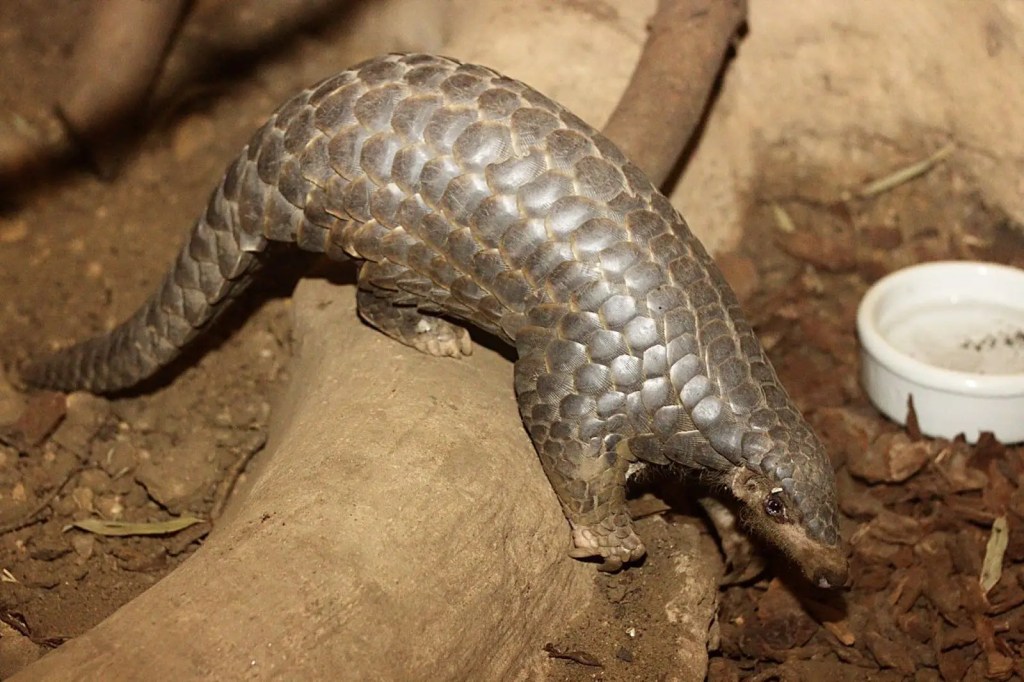
Decades of relentless poaching have decreased Chinese pangolin populations by over 90%, driving the species to the absolute brink of extinction. However, a recent wave of conservation efforts have created a glimmer of hope. Several laws have been passed in hopes of protecting the species, however due to their slow reproductive cycle, populations are only gradually showing signs of recovery. By understanding the complex and unique behaviors and habits of Chinese pangolins, scientists can give them a chance at recovery.
| Common Name | Chinese Pangolin |
| Binomial | Manis pentadactyla |
| Class | Mammalia |
| Order | Pholidota |
| Family | Manidae |
| Biogeographical Realm | indomalayan |
| IUCN Status | Critically Endangered |
Adaptations and Behavior
Chinese pangolins have evolved to have a variety of unique adaptations that have allowwed them to survive in their natural habitats. These relatively small mammals typically weigh between 2-7 kg, with males generally being larger than females. Their bodies are covered in overlapping scales made of keratin, the same material found in human fingernails. These tough scales form a protective layer of armor, allowing them to curl into a tight ball when threatened by predators. Their small, pointed heads, narrow mouths, large external ears, and relatively short, thick tails give them a distinct helmet-like appearance. However, this unusual defense mechanism offers little protection against poachers, who can simply pick up the curled-up animal.
Chinese pangolins are primarily nocturnal and solitary animals, spending most of their lives underground. They are considered fossorial mammals, meaning they are specially adapted for digging and living in burrows. Their long, powerful claws allow them to dig through soil and construct shelters, while their strong limbs help them move through hard terrain. To protect these claws from damage, pangolins walk with their front claws folded underneath their feet. Although they are primarily ground-dwelling animals, Chinese pangolins are also capable swimmers and climbers. They occupy a wide range of habitats, including tropical and subtropical forests, bamboo forests, limestone forests, and grasslands
Another important trait is their slow reproductive cycle. Female Chinese pangolins generally give birth to only one offspring at a time, which they care for during its early development. Young pangolins often ride on their mother’s tail while she searches for food, remaining close to her until they become independent. With an estimated generation length of around seven years, Chinese pangolin populations can take a considerable amount of time to recover from population declines. This makes the species particularly vulnerable to hunting and habitat destruction, as individuals cannot be replaced quickly enough to compensate for heavy losses.
Diet and Feeding

Chinese pangolins are insectivores, feeding on almost only ants and termites. Despite their relatively poor eyesight, they possess an excellent sense of smell, allowing them to locate insect colonies hidden beneath the ground or inside decaying wood. Once a nest has been located, they use their large, curved claws to break it open before extending their long, thin, sticky tongues to collect the insects inside. Their tongues can reach approximately 40 centimeters in length, allowing them to reach insects deep within narrow tunnels. These specialized feeding adaptations are remarkably similar to those of anteaters and aardvarks, despite these animals not being closely related. This is an example of convergent evolution, where unrelated species develop similar characteristics as a result of adapting to similar conditions and environments
However, feeding on thousands of insects presents several challenges. Ants and termites often defend their colonies by biting, so pangolins have developed thick eyelids and the ability to close their ears and nostrils to prevent insects from entering. Unlike most mammals, pangolins also lack teeth and cannot chew their food. Instead, their muscular stomachs grind up insects with the help of small stones and sand swallowed during feeding. These traits have allowed Chinese pangolins to obtain nutrients from their highly specialized diet without the need for teeth.
Conservation and Protection

Chinese pangolins play an important role in maintaining healthy ecosystems by keeping ant and termite populations in check and creating burrows that provide shelter for other species. However, despite their ecological importance, human activity has driven their populations toward extinction. For decades, widespread poaching has been fueled by demand for their meat, considered a luxury food in some regions, and their scales, which have historically been used in traditional medicine. Habitat destruction and agricultural expansion have further threatened the species by reducing their available living space. These threats along with their slow reproductive cycle, make population recovery particularly difficult.
To combat this decline, several national and international laws have been created to protect pangolins. In 2016, all eight pangolin species were placed under Appendix I of the Convention on International Trade in Endangered Species (CITES), prohibiting international commercial trade in pangolins and their body parts beginning in January 2017. China further strengthened its protections in June 2020 by upgrading pangolins to Class I protected wildlife, the country’s highest level of protection. That same year, pangolin scales were removed from China’s official pharmacopoeia, although some tightly regulated medicinal uses have remained permitted. Despite these legal advances, illegal wildlife trafficking continues to threaten the species, highlighting the importance of stronger enforcement and reducing consumer demand.
Conservation efforts have also begun to show promising results, particularly in Taiwan, where stronger wildlife protection laws, rehabilitation programs, and public awareness have helped some Chinese pangolin populations recover. Zoos have also contributed to these efforts through captive breeding and scientific research. Taipei Zoo has made significant progress in caring for and breeding Chinese pangolins, while Prague Zoo successfully raised the first Chinese pangolin born in a European zoo in 2023. These programs have allowed scientists to better understand pangolin behavior and reproduction, potentially improving future conservation efforts. However, captive breeding remains challenging, and protecting natural habitats is still needed for the species’ long-term survival.
Although Chinese pangolins remain critically endangered, individuals can also contribute to their recovery. Refusing to purchase products made from pangolins, reporting suspected illegal wildlife trade, and spreading awareness about the species can help reduce demand and discourage poaching. Supporting conservation organizations through donations, volunteering, or awareness campaigns can also provide resources for wildlife rehabilitation, habitat protection, and research. Ultimately, the survival of Chinese pangolins depends on the combined efforts of governments, conservationists, and the public. With continued legal protection and conservation efforts, there is still hope that these unique mammals can recover from decades of population decline.
Sources
“Chinese Pangolin.” EDGE of Existence, http://www.edgeofexistence.org/species/chinese-pangolin. Accessed 19 Sept. 2026.
———. Pangolin Specialist Group, pangolinsg.org/portfolio/chinese-pangolin/. Accessed 19 Sept. 2026.
“Chinese Pangolin (Manis Pentadactyla) | U.S. Fish & Wildlife Service.” FWS.Gov, 2016, http://www.fws.gov/species/chinese-pangolin-manis-pentadactyla. Accessed 20 Sept. 2026.
“Chinese Pangolin – Facts, Diet, Habitat & Pictures on Animalia.Bio.” Animalia.Bio, animalia.bio/chinese-pangolin. Accessed 19 Sept. 2026.
“Chinese Pangolin Facts.” Animals, 19 Dec. 2018, http://www.nationalgeographic.com/animals/mammals/facts/chinese-pangolin. Accessed 20 Sept. 2026.
“Chinese Pangolin | CITES.” Cites.Org, 2021, cites.org/eng/gallery/species/mammal/chinese_pangolin.html. Accessed 20 Sept. 2026.
Ching-Min, Nick, et al. “IUCN Red List of Threatened Species: Manis Pentadactyla.” IUCN Red List of Threatened Species, Name, 10 May 2019, http://www.iucnredlist.org/fr/species/12764/168392151. Accessed 20 Sept. 2026.
Natural History Museum. “About Pangolins (Order Pholidota): Feeding.” Q?Rius, qrius.si.edu/taxonomy/term/12162. Accessed 4 Nov. 2026.
“Pangolins | U.S. Fish & Wildlife Service.” FWS.Gov, 2016, http://www.fws.gov/international-affairs/pangolins. Accessed 4 Nov. 2026.
Raynor, Shelley. “Manis Pentadactyla (Chinese Pangolin).” Animal Diversity Web, 2000, animaldiversity.org/accounts/Manis_pentadactyla/. Accessed 4 Nov. 2026.
Save Pangolins. “How to Help – Save Pangolins.” Save Pangolins, Save Pangolins, 2026, http://www.savepangolins.org/donate. Accessed 4 Nov. 2026.
“Save Pangolins.” Save Pangolins, 2022, http://www.savepangolins.org/. Accessed 4 Nov. 2026.
Schueman, Lindsey Jean, and One Earth. “Meet the Chinese Pangolin: One of Asia’s Most Threatened Mammals.” One Earth, 12 Aug. 2026, http://www.oneearth.org/species-of-the-week-chinese-pangolin/. Accessed 19 Sept. 2026.
Su, Da, et al. “China’s Legal Protection System for Pangolins: Past, Present, and Future.” Animals, vol. 15, no. 16, Aug. 2025, pp. 2422–22, https://doi.org/10.3390/ani15162422. Accessed 20 Sept. 2026.
Sun, Nick Ching-Min, Bharti Arora, et al. “Mortality and Morbidity in Wild Taiwanese Pangolin (Manis Pentadactyla Pentadactyla).” PLOS ONE, edited by Christopher James Johnson, vol. 14, no. 2, Feb. 2019, p. e0198230, https://doi.org/10.1371/journal.pone.0198230.
Sun, Nick Ching-Min, Chun-Chieh Liang, et al. “Prey Composition and Seasonal Dietary Patterns of Chinese Pangolins in Southeast Taiwan.” Global Ecology and Conservation, Jan. 2025, pp. e03444–44, https://doi.org/10.1016/j.gecco.2025.e03444.
Sun, Song, et al. “Chinese Pangolin Changes Local Vertebrate Assemblages and Contributes to Their Interspecific Interactions by Burrowing and Revisitation.” Integrative Zoology [Australia], vol. 21, no. 3, May 2026, pp. 499–510. PubMed, https://doi.org/10.1111/1749-4877.12946. Accessed 19 Sept. 2026.
Taipei City Government. “Taipei City Government.” Taipei City Government, 27 Aug. 2026, english.gov.taipei/News_Content.aspx?n=A11F01CFC9F58C83&s=0B2E405B307F9BAA&sms=DFFA119D1FD5602C. Accessed 4 Nov. 2026.
Waterman, Carly. Pangolins. Academic Press, 2019.
World Animal Protection. “Chinese Pangolin Facts, Habitat, and Why They’re Endangered.” World Animal Protection, 21 Apr. 2026, http://www.worldanimalprotection.org/latest/blogs/chinese-pangolin/. Accessed 19 Sept. 2026.
Wu, Shibao, et al. “Chinese Pangolin Manis Pentadactyla (Linnaeus, 1758).” Pangolins, 2020, pp. 49–70, https://doi.org/10.1016/b978-0-12-815507-3.00004-6. Accessed 19 Sept. 2026.
Zoo, Taipei. “Taipei Zoo.” Taipei Zoo, 26 July 2009, english.zoo.gov.taipei/. Accessed 20 Sept. 2026.
“ZooChat :: Zoo and Animal Conservation Community.” ZooChat, http://www.zoochat.com/community/. Accessed 4 Nov. 2026.


Leave a Reply